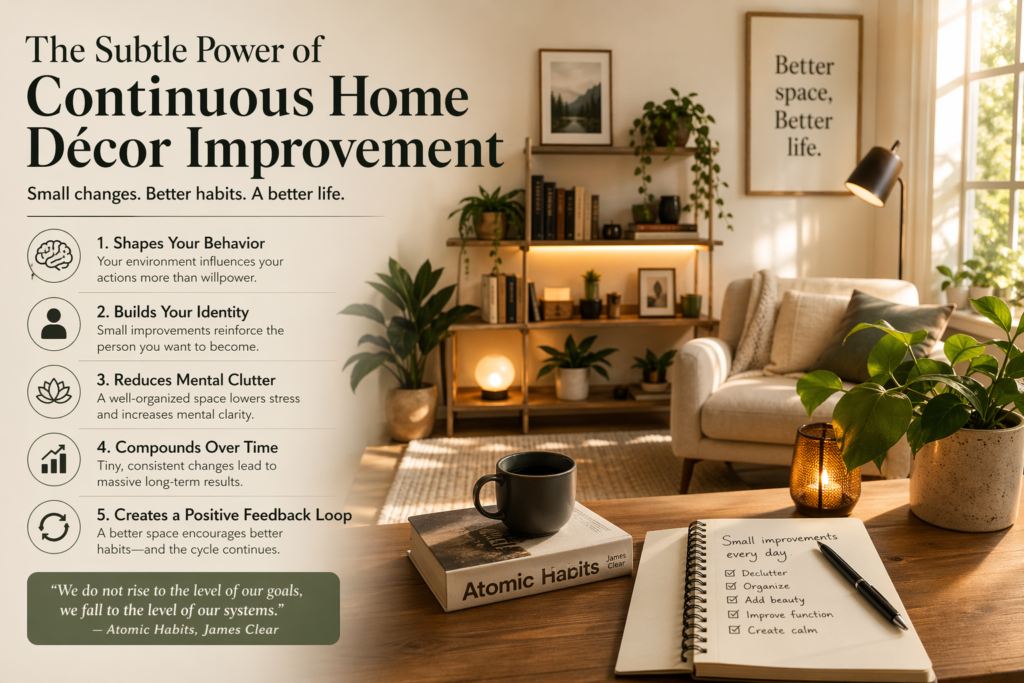
Home is often treated as a fixed environment—something we “set up once” and then live inside. Yet in reality, our living space is not static. It is a psychological system that interacts with our habits, emotions, productivity, and even identity. Continuous home décor improvement—small, ongoing refinements rather than occasional major renovations—can have a surprisingly deep impact on mental well-being, discipline, and life direction.
This idea aligns strongly with modern behavioral science and habit theory, particularly the work of Atomic Habits by James Clear, which emphasizes that small, consistent improvements compound over time to produce significant life outcomes.
1. Environment Shapes Behavior More Than Willpower
One of the most important insights from habit research is that behavior is heavily influenced by environment. In Atomic Habits, James Clear explains that we do not rise to the level of our goals, but fall to the level of our systems. Our surroundings are a major part of that system.
A well-organized, aesthetically intentional home reduces friction for good habits and increases friction for bad ones. For example:
- A clean, minimal desk encourages focused work
- A visible book on a table increases reading probability
- A cluttered room increases mental fatigue and procrastination
This means that continuous home décor improvement is not about decoration alone—it is about behavioral engineering.
2. Small Changes Create Identity Shifts
Another powerful idea from Atomic Habits is that habits are identity-based. We do not only change what we do; we change who we are by reinforcing small evidence of identity.
When you continuously improve your home environment, even in minor ways—adding plants, organizing shelves, improving lighting—you are repeatedly sending yourself a message:
“I am someone who values order, beauty, and progress.”
Over time, this environment reinforces self-perception. A person living in a cared-for space is more likely to behave as someone disciplined, intentional, and growth-oriented.
3. The Psychology of Clutter and Mental Load
Research in environmental psychology consistently shows that cluttered spaces increase cognitive load. The brain interprets visual chaos as “unfinished tasks,” which drains attention and increases stress.
Continuous improvement of home décor works like mental hygiene:
- Removing unnecessary objects reduces subconscious tension
- Improving lighting can improve mood and circadian rhythm
- Better spatial organization reduces decision fatigue
Even small interventions—like rearranging a corner or improving desk layout—can produce measurable changes in mental clarity.
4. The Compounding Effect of Micro-Improvement
A central theme in Atomic Habits is compounding—small improvements, repeated consistently, produce exponential results over time.
Applied to home décor:
- Adding one meaningful improvement every week (a lamp, a plant, a framed image, better storage)
- Removing one source of clutter regularly
- Refining layout based on daily usage patterns
These incremental adjustments gradually transform a space from “functional” to “optimized,” without the financial or psychological burden of large renovations.
This is important because humans often fail at big transformations but succeed at small refinements.
5. Home as a Feedback System
Your home is not just a passive space—it is a feedback system that influences your habits daily.
A continuously improved environment:
- Rewards discipline (clean, structured spaces feel satisfying)
- Punishes neglect (mess becomes more noticeable over time)
- Encourages reflection (you notice what is not working)
This feedback loop helps individuals self-correct without external pressure. In this sense, home décor becomes a silent coach shaping behavior.
6. Emotional Stability and Aesthetic Comfort
There is also an emotional dimension. Humans are deeply responsive to beauty, symmetry, light, and natural elements.
Continuous home improvement—especially when it includes natural elements like plants, warm lighting, or balanced layouts—can:
- Reduce anxiety levels
- Improve mood stability
- Increase sense of control in life
Even small aesthetic upgrades signal care and stability to the subconscious mind. This is especially important during stressful life phases, where external order can compensate for internal uncertainty.
7. The Deeper Philosophy: Living as an Evolving System
Perhaps the most important shift is philosophical: seeing your home not as a completed project, but as an evolving system.
This mindset aligns with the core message of Atomic Habits—that improvement is not a one-time event but a continuous process of refinement.
A home that evolves with its owner becomes a mirror of personal growth. It reflects who you are becoming, not just who you are today.
Conclusion
Continuous home décor improvement is far more than interior design. It is a behavioral strategy, a psychological tool, and a form of identity shaping.
By applying the principles found in habit science—especially those articulated in Atomic Habits—we can understand that even small, consistent changes in our environment compound into meaningful transformations in mindset, productivity, and emotional well-being.
In the long run, your home is not just where you live. It is what quietly shapes how you live.
Follow Us on Pintrest for updates and inspirations.