The Breeze Above: The Story of the Ceiling Fan
On a hot summer afternoon, when the air feels heavy and still, many people instinctively look upward and switch on a ceiling fan. Within seconds, a gentle breeze begins to move through the room, making the space feel lighter and more comfortable. It is such a common object in homes, offices, and classrooms that we rarely stop to think about its story. Yet the ceiling fan has a fascinating history that stretches back more than a century.

The Earliest Idea of Moving Air
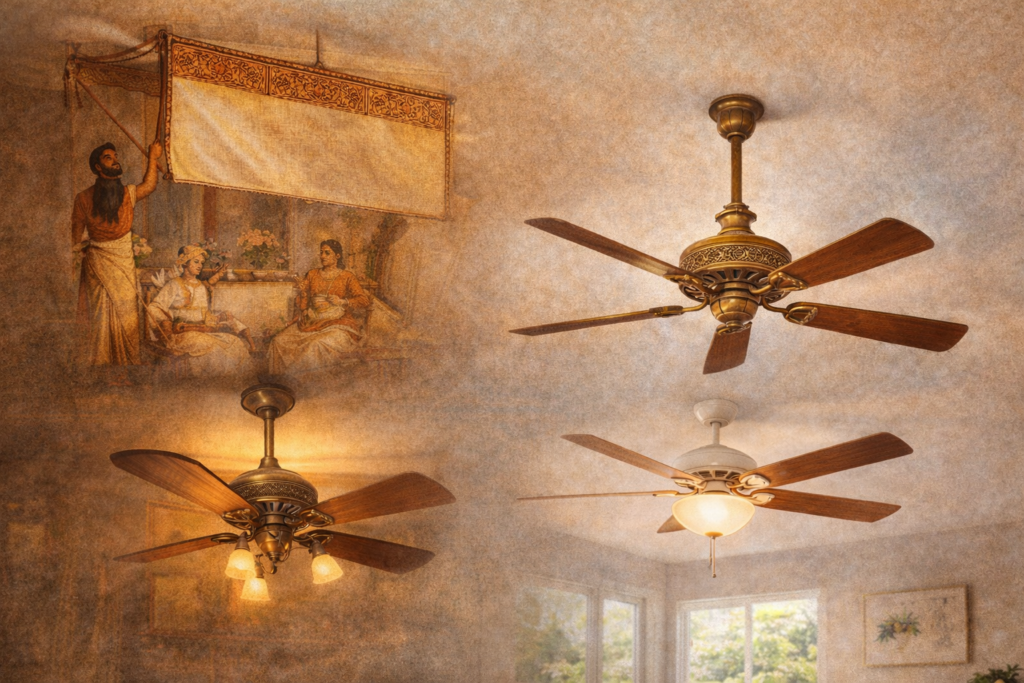
Long before electricity existed, people tried many clever ways to create airflow indoors. In ancient times, wealthy households in places like India, the Middle East, and parts of Asia used large hand-operated fans called punkahs. These were wide cloth fans suspended from the ceiling. A servant would pull a rope repeatedly to swing the fan back and forth, pushing air across the room. It was an early attempt at cooling indoor spaces, though it required constant human effort.
By the nineteenth century, the Industrial Revolution introduced new mechanical systems powered by steam and water. In large buildings such as restaurants and hotels, engineers began experimenting with ceiling-mounted fans connected to a central water turbine. Long belts ran across the ceiling, rotating several fan blades at once. These systems were noisy and complicated, but they proved one important idea: moving air from above could cool an entire room.
The Birth of the Electric Ceiling Fan
The true breakthrough came in 1882, when an American inventor named Philip Diehl created the first practical electric ceiling fan. Diehl was working with the new electric motors used in early sewing machines. One day, he realized that if he attached fan blades to a small electric motor and mounted it on the ceiling, it could spin continuously without belts, turbines, or human labor.
His invention was revolutionary. For the first time, a single device could circulate air smoothly and quietly using electricity. Diehl’s design soon spread across homes, offices, and public buildings, especially in warm regions where ventilation was essential.
The Fan Becomes a Household Companion
In the early twentieth century, ceiling fans became symbols of modern comfort. As electricity spread to cities around the world, companies began manufacturing fans in large numbers. Heavy cast-iron fans with polished brass blades appeared in hotels, railway stations, and colonial houses. Many of these early fans were extremely durable—some are still working today.
Over time, technology improved. Motors became quieter and more efficient. Designers added multiple blades to create smoother airflow. Speed controls allowed people to adjust the breeze according to their comfort.
By the mid-1900s, the ceiling fan had become a common feature in homes across tropical and subtropical regions. In countries like Pakistan, India, and many parts of Asia, it became almost impossible to imagine daily life without one slowly rotating above the room.
From Utility to Design
Today, ceiling fans are not only practical appliances but also pieces of interior design. Modern fans come in sleek metal finishes, wooden blades, minimalist styles, and even smart models controlled by remote or smartphone apps. Some include built-in lights, combining illumination and cooling in a single elegant fixture.
Despite the rise of air conditioners, ceiling fans remain remarkably relevant. They use far less electricity while still improving comfort by circulating air. Many people now use them together with air conditioning to reduce energy consumption and keep rooms cooler.
A Simple Invention That Changed Comfort
The ceiling fan may not seem like a dramatic invention compared to airplanes or computers. Yet its impact on daily life has been profound. It quietly improved comfort in homes, classrooms, hospitals, and workplaces around the world.
Above our heads, the blades spin steadily—day after day, year after year—creating a gentle breeze that reminds us how a simple idea, combined with human ingenuity, can transform everyday life.
Sometimes the most important inventions are the ones we barely notice, quietly turning above us.